Master Yin Shun’s Chronology (B1)
印順導師年表(B1)
No audio is available for this stop yet. Please read the text below.
Chronology (Brief Biography)
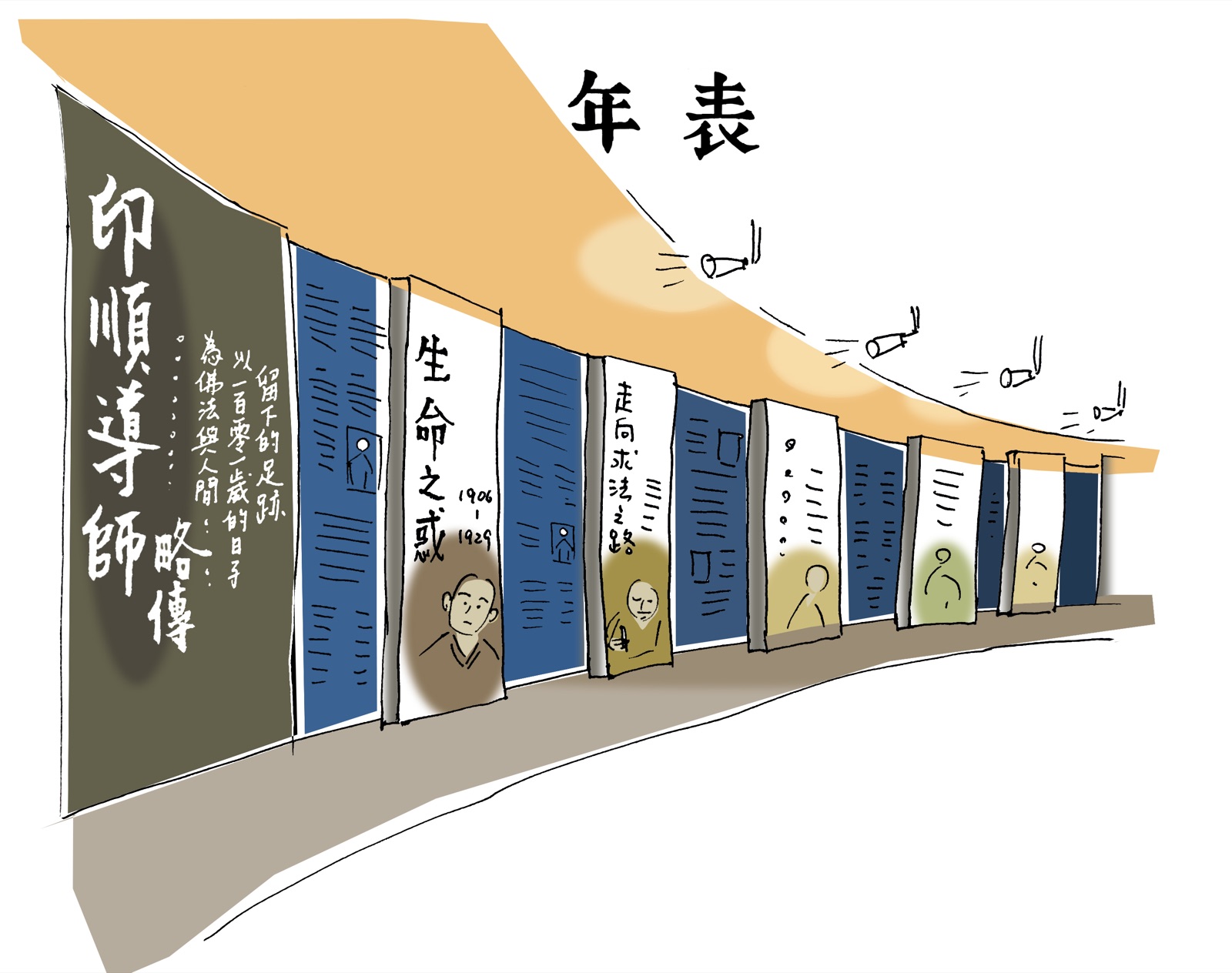
As you enter the exhibition hall, Master Yin Shun’s chronology unfolds along the curved wall like a long scroll. The understated, monastic tones of the exhibition design evoke the Master’s disciplined and simple way of life. The main thematic panels draw on his autobiography to highlight key milestones, bringing together text, historical photographs, and excerpts from his writings to convey the depth and significance of his Buddhist thought.
Throughout his life, Master Yin Shun devoted himself to the study of Buddhism. His monumental body of work, totaling more than 7.5 million Chinese characters, helped renew hope in Chinese Buddhism and brought the boundless joy of the Dharma to generations of readers.
1. The Search for Meaning in Life (1906–1929)
Master Yin Shun’s Early Years and Search for Meaning
Master Yin Shun, whose lay name was Chang Lu-Chin, was born in Haining, Zhejiang Province. After experiencing the pain of separation from and loss of loved ones, along with periods of profound inner solitude, he began to ponder the ultimate questions of life and death. His encounter with the Dharma set him on a journey to unravel the fundamental questions of human existence.
2. Embarking on the Quest for the Dharma (1930–1940)
Ordination and Deep Study of the Buddhist Canon
After receiving ordination at Mount Putuo in 1930, Master Yin Shun traveled to southern Fujian and studied at the Wuchang Buddhist Institute and the Sino-Tibetan Institute of Buddhist Studies, immersing himself in the vast body of the Buddhist canon. Confronted by the worldly and superstitious practices prevalent in Buddhism at the time, he resolved to “trace the Dharma back to its origins” and clarify the Buddha’s original, pure intention in appearing in this world.
3. Discovering the Buddha in the Human World (1938–1951)
Exploring the Canon and a Turning Point in His Thought
As World War II spread and China was plunged into turmoil, Master Yin Shun was deeply drawn to the Agamas, whose teachings conveyed a sense of truth and immediacy that was closely connected to human life. This encounter profoundly influenced his thinking, inspiring him to ground Buddhism in human life and to develop the vision and aspiration of Humanistic Buddhism.
4. Spreading the Dharma with Compassion (1952–1963)
Bringing the Dharma to Taiwan and Laying the Foundations for His Thought
These were years of constant travel and tireless Dharma teaching. Over the course of twelve years, Master Yin Shun first moved to Hong Kong and later settled in Taiwan. He also traveled to Japan, Thailand, and other parts of Southeast Asia, spreading the Dharma through teaching, establishing temples, and other activities. During this period, he founded Fuyan Monastery and Hui Ri Lecture Hall, dedicating himself to the education and training of monastics and giving profound expression to the Bodhisattva aspiration to benefit and liberate all beings.
5. The Dharma Rain of Miaoyun Nourishing the Human World (1964–2005)
Major Works and the Enduring Legacy of His Thought
After years of teaching the Dharma at home and abroad, Master Yin Shun entered retreat and devoted himself to intensive study and writing. During this period, he compiled the Miaoyun Collection and received a doctoral degree from Taisho University in Japan for his landmark work, A History of Chinese Zen Buddhism. In his later years, he continued to write, completing other major works, including the Huayu Collection, and did not put down his pen until the age of ninety.
In 2005, Master Yin Shun passed away peacefully at the age of one hundred. His lifelong dedication to “offering body and mind for the benefit of all beings” continues to inspire and influence the Chinese Buddhist community.
A Brief Biography of Master Yin Shun
Master Yin Shun was born in Haining, Zhejiang Province, on the twelfth day of the third month of the lunar calendar in 1906. His lay name was Chang Lu-Chin. On October 11, 1930, he was ordained at Fuquan Monastery under Venerable Ching-Nien, receiving the Dharma name Yin Shun and the courtesy name Sheng-Cheng. He subsequently went to Tiantong Temple, where he received full monastic ordination.
Master Yin Shun was renowned for his profound learning and exemplary practice, earning the deep respect of Buddhists in Taiwan and abroad. In 1967, he received the honorary title of Philosopher from the China Academy. In 1973, Taisho University in Japan awarded him a doctoral degree for his original scholarship in A History of Chinese Chan Buddhism.
In his youth, Master Yin Shun studied and worked with Master Tai-Hsu, contributing to the advancement of Buddhist education. After coming to Taiwan, he served as a professor at Chinese Culture University, as abbot of Shandao Temple and Fuyan Monastery, and as a teacher at Fuyan Buddhist College, Hui Ri Lecture Hall, and Huayu Temple. He also traveled abroad on numerous occasions to teach and propagate the Dharma, serving as chairman of the Hong Kong Buddhist Association and principal of Neng-Jen Middle School in the Philippines, as well as a senior resident monk at Hsin-Yuan Temple and Hua-Tsang Temple.
For several decades, Master Yin Shun devoted himself tirelessly to Buddhist study and writing, producing dozens of books and earning widespread recognition in both Buddhist and academic circles. In his later years, he continued to publish major works that received particular acclaim from scholars in Taiwan and abroad. His distinctive insights into the interpretation and classification of Indian Buddhist thought, as well as his studies of the history of Chinese Chan Buddhism, were highly original and differed significantly from conventional scholarship. Few scholars since the late Tang dynasty had achieved comparable distinction.
Later, Master Yin Shun established Miaoyun Temple, where he entered retreat and devoted himself to further study and writing. His spiritual influence and scholarly stature continued to grow, and he came to be recognized internationally as a leading Buddhist scholar and a national treasure.
Written in calligraphy by his disciple, Miao-Feng, October 27, 1991A Chronology of Master Yin Shun
- Age 1 (1906) Born in Haining County, Zhejiang Province. His lay name was Chang Lu-Chin. 1 歲(民國前 6 年)出生於浙江海寧縣,俗姓張,名「鹿芹」
- Age 25 (1930) Ordained as a Buddhist monk, receiving the Dharma name Yin Shun and the courtesy name Sheng-Cheng. 25 歲(民國 19 年)落髮出家,法名印順,號盛正
- Age 47 (1952) Came to Taiwan and served as Spiritual Director (Mentor) of Shandao Temple in Taipei. 47 歲(民國 41 年)來臺灣,擔任台北市善導寺導師
- Age 48 (1953) Founded Fuyan Monastery (Fuyan Buddhist Institute) in Hsinchu. 48 歲(民國 42 年)在新竹創建福嚴精舍
- Age 52 (1957) Appointed Dean of Yi Tung Buddhist College for Nuns. 52 歲(民國 46 年)任壹同寺女眾佛學院院長
- Age 55 (1960) Established Hui Ri Lecture Hall (Light of Wisdom Dharma Hall) in Taipei. 55 歲(民國 49 年)在台北成立慧日講堂
- Age 59 (1964) Entered meditation retreat at Miaoyun Temple in Chiayi and devoted himself to Buddhist study and writing. 59 歲(民國 53 年)5 月 26 日於嘉義妙雲蘭若掩關寫作
- Age 60 (1965) Received the honorary title of Philosopher from the China Academy, becoming the first Bhikkhu professor in Taiwan. 60 歲(民國 54 年)中華學術學院授以哲士榮銜,為全台首位比丘教授
- Age 68 (1973) Awarded a doctoral degree by Taisho University in Japan for his landmark work, A History of Chinese Zen Buddhism, making him the first Bhikkhu in Chinese history to earn a doctoral degree. 68 歲(民國 62 年)所著《中國禪宗史》獲日本大正大學授於博士學位,為中國第一位博士比丘
- Age 73 (1978) Moved to Huayu Monastery in Taiping Township, Taichung. 73 歲(民國 67 年)移居台中太平鄉華雨精舍
- Age 90 (1995) Concluded his writing career, leaving behind a lifetime body of work totaling more than 7.5 million Chinese characters. 90 歲(民國 84 年)停筆寫作,畢生著作七百五十萬字
- Age 100 (2004) On March 5, received the Order of Propitious Clouds, Second Class, from the Presidential Office, the Republic of China. 100 歲(民國 93 年)3 月 5 日受贈總統府「二等卿雲勳章」
- Age 101 (2005) Passed away peacefully on June 4. The Presidential Office posthumously issued a Presidential Commendation in recognition of his lifelong contributions. 101 歲(民國 94 年)6 月 4 日安詳圓寂,總統府頒贈褒揚令
- * In the traditional lunar-calendar system, age is traditionally counted as one year older than a person’s actual age. *年齡依傳統虛歲計算